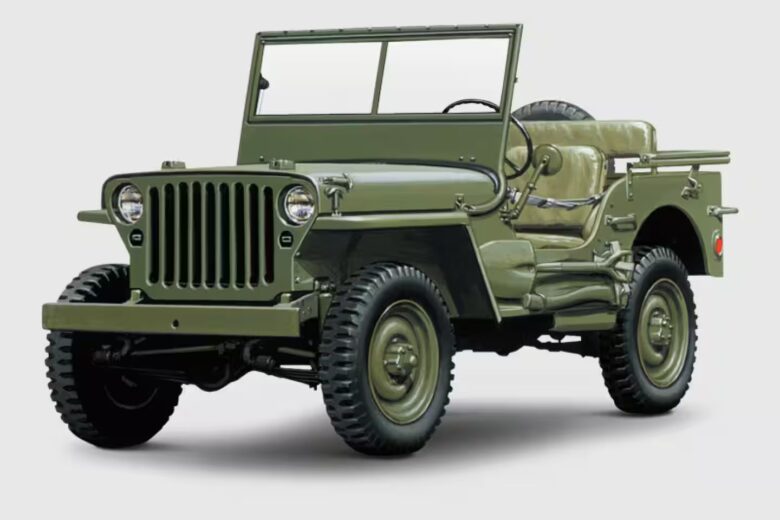
The WWII Willys Jeep — When you picture World War II in motion, chances are you see a rugged little vehicle bouncing across battlefields, ferrying troops, gear, and grit. That’s the Willys MB Jeep—America’s quarter-ton warhorse that became a symbol of mobility, ingenuity, and freedom.
The WWII Willys Jeep

Was It Easy to Assemble?
In a word: yes—by design. The Willys MB was engineered for simplicity and speed. Its compact build, standardized parts, and no-frills mechanics made it easy to produce and repair in the field. Over 640,000 units were built between 1941 and 1945, with Willys-Overland and Ford sharing production duties. The body was so standardized that parts from a Willys MB could be swapped with a Ford GPW without skipping a beat A.

Assembly was streamlined to meet wartime urgency. The vehicle’s leaf-spring suspension, flat fenders, and boxy frame weren’t just utilitarian—they were a mechanic’s dream. Soldiers could fix it with basic tools, and its modular design meant it could be shipped in crates and reassembled quickly.
The image of a Willys Jeep tucked into a wooden crate isn’t just a logistical marvel—it’s a metaphor for wartime ingenuity. These boxed-up warriors could be dropped into ports, rail yards, or jungle outposts, then assembled in hours by soldiers who’d never seen one before. It was plug-and-play before the term existed. The crate itself became a symbol of readiness: inside was not just a vehicle, but mobility, communication, and tactical advantage waiting to be unleashed.
General Purpose or Something Else?
The name “Jeep” has sparked decades of debate. One popular theory is that it came from the military designation “GP,” which some believed stood for “General Purpose.” Soldiers, the story goes, slurred “GP” into “Jeep,” and the name stuck B.
But here’s the twist: “GP” didn’t officially mean “General Purpose.” In Ford’s internal coding, “G” referred to a government contract vehicle, and “P” indicated an 80-inch wheelbase reconnaissance car C. So while “General Purpose” makes for a tidy explanation, it’s more myth than fact.
Another origin story points to “Eugene the Jeep,” a magical creature from the Popeye cartoons, known for going anywhere and doing anything. Soldiers familiar with the character may have borrowed the name for their go-anywhere vehicle B.
Legacy on Wheels
The Willys Jeep wasn’t just a vehicle—it was a revolution in military mobility. It could climb hills, ford streams, and squeeze through tight terrain. It hauled radios, weapons, stretchers, and even generals. Its versatility made it indispensable, and its silhouette became iconic.
Today, the Jeep brand carries that legacy forward, but the original Willys MB remains a testament to wartime innovation and the power of smart, simple design.


Steve is a collector of rubber ducks. At SteveZ DuckZ, Steve will share off his rubber duck collection and share blog post relating to rubber ducks. If you love rubber ducks, please follow on social media or subscribe!
Duckies Like Sharing:

Discover more from SteveZ DuckZ
Subscribe to get the latest posts sent to your email.